

Deployment Date: December 2025
Project Location: To Kwa Wan, Hong Kong S.A.R.
2 min read
Together with Leyden Power, Allied Success Construction Limited successfully cuts 89% construction emissions for a public housing construction project in one of Hong Kong’s urban neighborhoods.
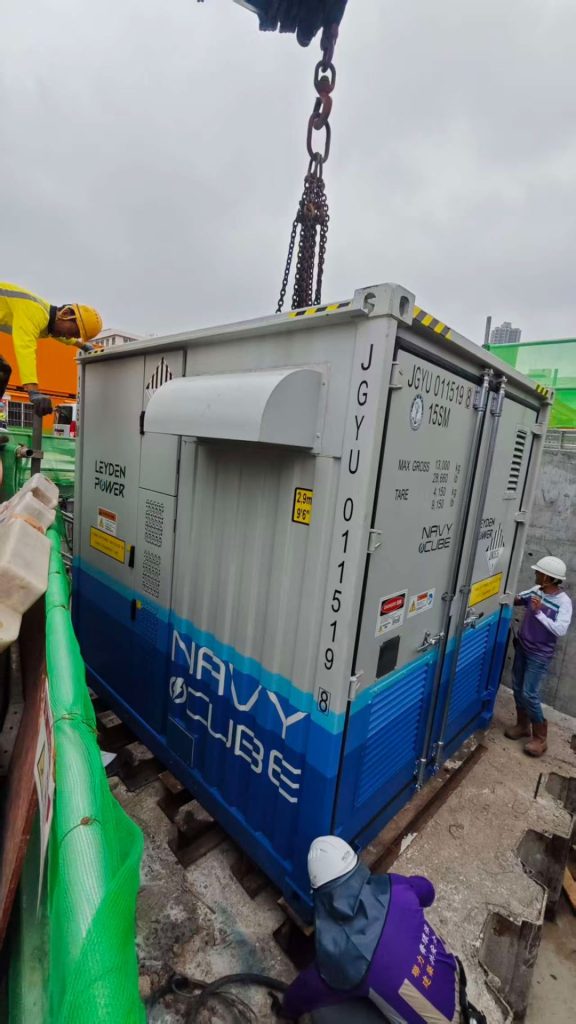
Hong Kong has ample stocks of aging buildings. In response to deteriorating structures of older districts, the government has outlined reconstruction of housing units in the city’s dense, urban neighborhoods. The Hong Kong Housing Authority, as the project’s developer, is appointed to work with Allied Success Construction Limited (“Allied Success”) to transform a site in To Kwa Wan Road into a public housing estate.
As the contractor, Allied Success needs a power solution that caters with the site’s constraints. Dense urban environments easily trap vehicle and industrial air pollution. The location also borders residential neighborhoods, which puts noise and air quality under scrutiny. At the same time, there is a need to expand on-site power that is insufficient for the fluctuating needs of construction loads.
To address these challenges, Leyden Power worked with Allied Success to deploy a NAVY CUBE 400 (422 kW / 633 kWh) battery energy storage system to power a single tower crane with a peak demand of 100 kW. The BESS charges through a 30 kW grid connection that begins automatically once the battery reaches a low state of charge.
Diesel gensets sized for crane loads typically run continuous cycles regardless of actual demand, burning fuel even during idle periods between lifts. A battery system, in comparison, draws only what the load requires and recharges from the grid during downtime.
The battery-crane setup keeps the crane running without an idling diesel generator nearby. More than the fuel bill, Allied Success also slashed loud mechanical noise, pollution, and operational expenses tied with using diesel as a power source.
Set against 12 hours of daily diesel generator use, the monthly deployment of the NAVY CUBE saves an approximate of 10.2 tons of CO2 monthly, cutting 89% of carbon output from crane operations.

Follow our page for more energy news and connect with our team to explore how BESS can power your next event.


