

Deployment Date: January 2026
Project Location: Chai Wan / Sha Tin, Hong Kong S.A.R.
3 min read
Road construction sites across urban spaces face the same two questions before work can begin: Is there enough space? Can the equipment run around the clock? Often, the answer to both has been no.
Unlike traditional construction sites with open, contiguous ground, roadwork operates in narrow corridors shared with live traffic, sidewalks, and existing utilities. That constraint drives equipment choices, where compact, mobile machinery becomes the only feasible option.
Noise and time restrictions add a second layer of pressure. Many roadwork sites have no grid power, which leaves diesel generators as the default. But diesel is loud and produces fumes, both of which violate restrictions common near residential areas and during night hours. This issue escalates when traffic management systems, lighting, monitoring equipment, and smaller tools need to stay active 24/7, regardless of what the site looks like after dark.
Battery energy storage has emerged as the practical answer to these constraints at once. Two road construction teams working with Leyden Power deployed the NAVY CAPSULE 125—a compact battery system—to reduce the runtime of noisy, fume‑emitting diesel generators on sites where conventional batteries are too large to be practical.
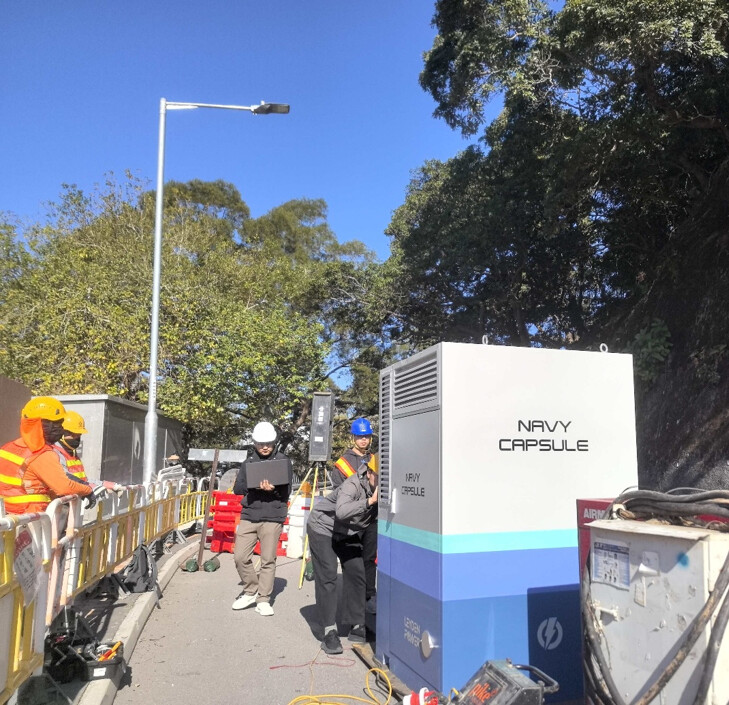
Sitting in a dense residential pocket of Chai Wan, Hong Kong, the site offered a narrow working footprint, with every square meter already claimed by materials, barriers, and machinery—crews needed to work within meters of apartment towers. With no grid connection available, the original choice was to run diesel generators through the night or shut equipment down until morning.
Neither worked. Generator noise near residential blocks invites complaints and regulatory scrutiny, while cutting power overnight risked compromising site monitoring and safety systems that needed to stay live.
The NAVY CAPSULE fits perfectly for the scenario. The CAPSULE ran continuously for roughly a month in January 2026, powering lighting loads across the site without a single diesel generator switched on after dark. Its silent and emission-free operation meant equipment could stay on 24/7 without violating noise restrictions. Its compact footprint (1.3 m x 1.3 m x 2.0 m) fits into the existing work zone without displacing materials or forcing logistics to redesign. With 211 kWh of stored capacity, the system covered overnight cycles without the pollution and maintenance schedule diesel units require.
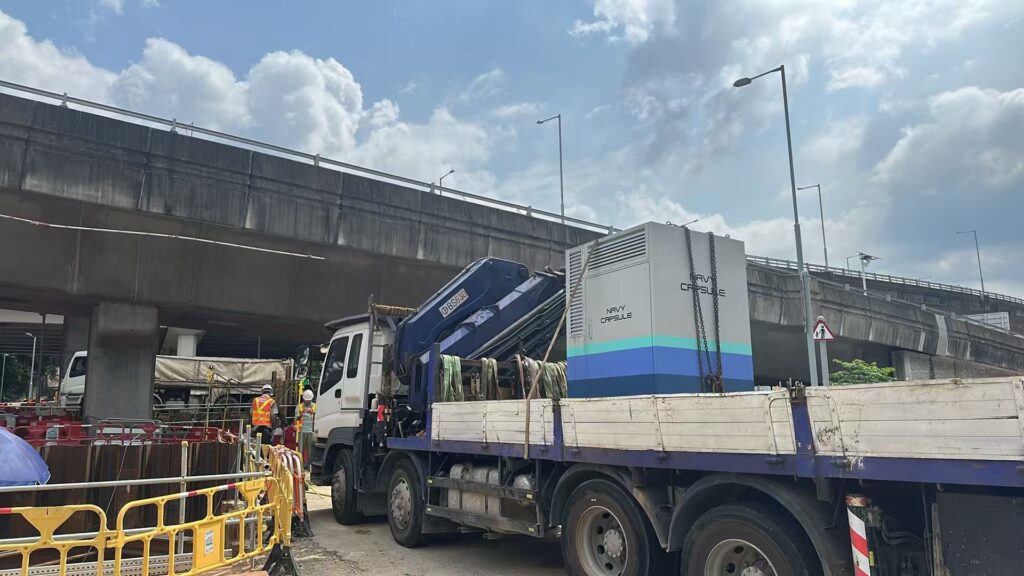
With the success of the Chai Wan deployment, Leyden Power participated in another construction project at the end of May 2026—this time, a trunk road construction in Sha Tin. Sharing the same underlying constraints—a narrow working corridor shared with active traffic and no grid access on-site—these conditions ruled out diesel as a workable option for continuous, unattended operation.
A NAVY CAPSULE was selected for the same reasons and is now running at the site. For smaller sites with grid unavailability, a compact battery that can run smaller equipment loads without the noise and space demands of a generator is rapidly becoming the standard.
Follow our page for more energy news and connect with our team to explore how BESS can power your next event.


